Semantic Trajectory Generation for Goal-Oriented Spacecraft Rendezvous

1Stanford University, Department of Aeronautics and Astronautics
2Stanford University, Department of Mechanical Engineering
AIAA SCITECH 2026 Forum

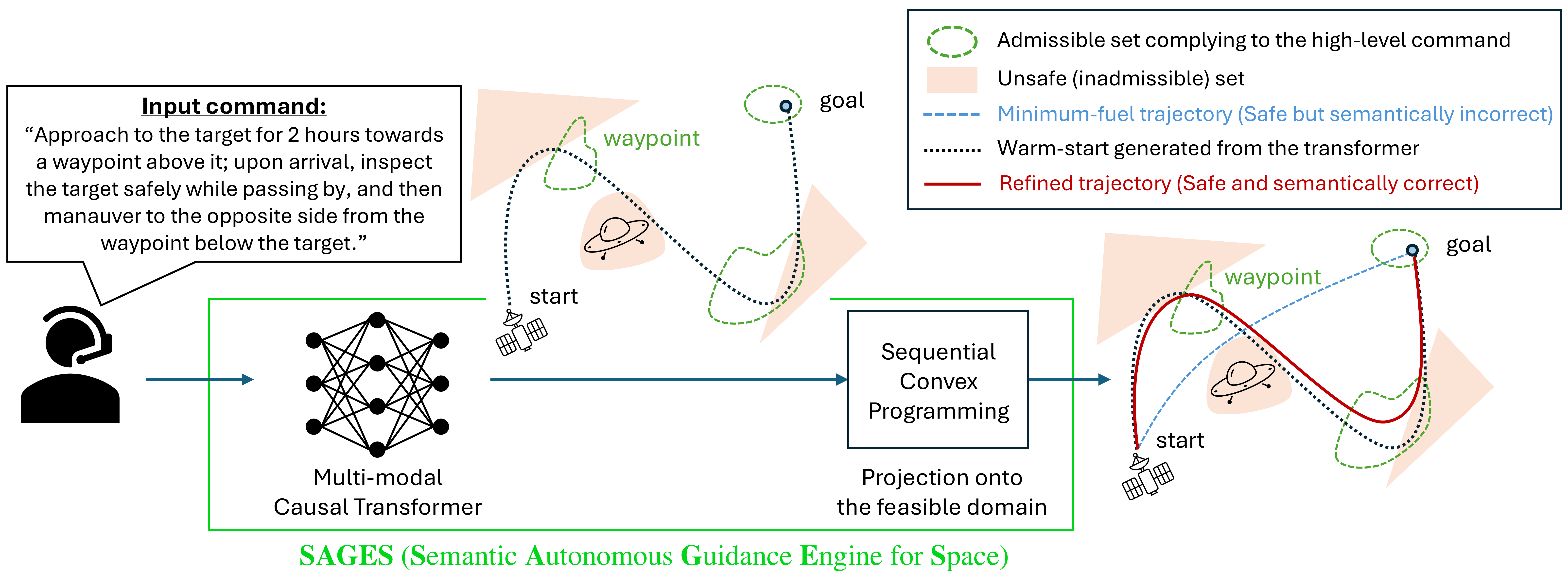
SAGES translates natural-language guidance into safe and executable trajectories with high-level intent captured.

Abstract

Reliable real-time trajectory generation is essential for future autonomous spacecraft. While recent progress in nonconvex guidance and control is paving the way for onboard autonomous trajectory optimization, these methods still rely on extensive expert input (e.g., waypoints, constraints, mission timelines, etc.), which limits the operational scalability in real rendezvous missions. This paper introduces SAGES (Semantic Autonomous Guidance Engine for Space), a trajectory-generation framework that translates natural-language commands into spacecraft trajectories that reflect high-level intent while respecting nonconvex constraints. Experiments in two settings—fault-tolerant proximity operations with continuous-time constraint enforcement and a free-flying robotic platform—demonstrate that SAGES reliably produces trajectories aligned with human commands, achieving over 90% semantic-behavioral consistency across diverse behavior modes. Ultimately, this work marks an initial step toward language-conditioned, constraint-aware spacecraft trajectory generation, enabling operators to interactively guide both safety and behavior through intuitive natural-language commands with reduced expert burden.

SAGES Framework and Architecture
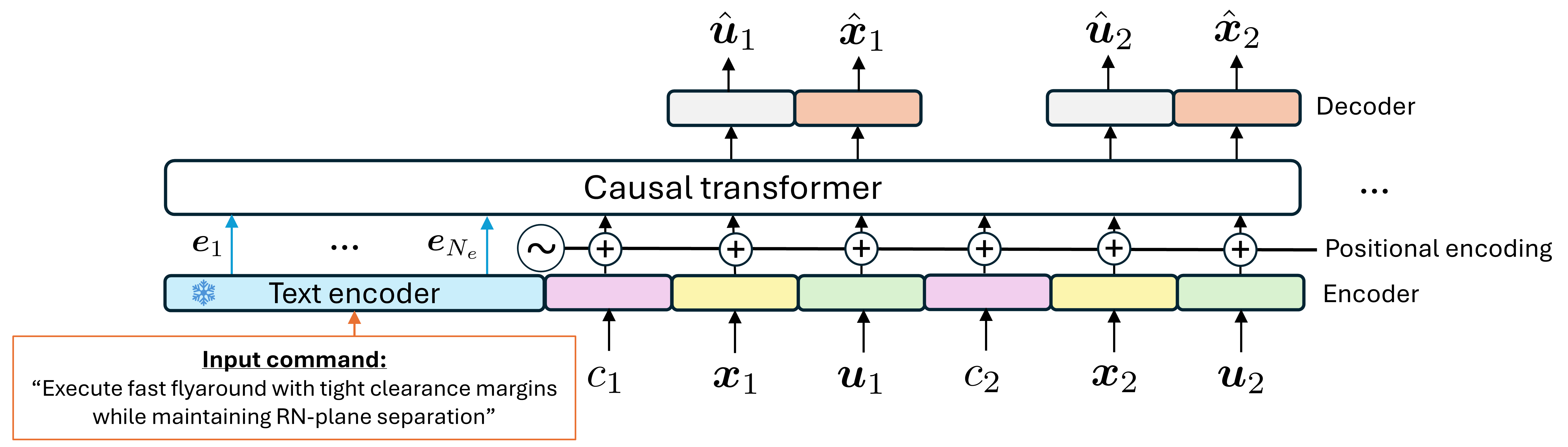
The following figure illustrates the neural network architecture used for semantic trajectory generation in SAGES. Natural-language task descriptions, constraint signals, system states, and control histories are embedded into a shared latent space, which is leveraged to autoregressively predict dynamically feasible trajectories.
Numerical results

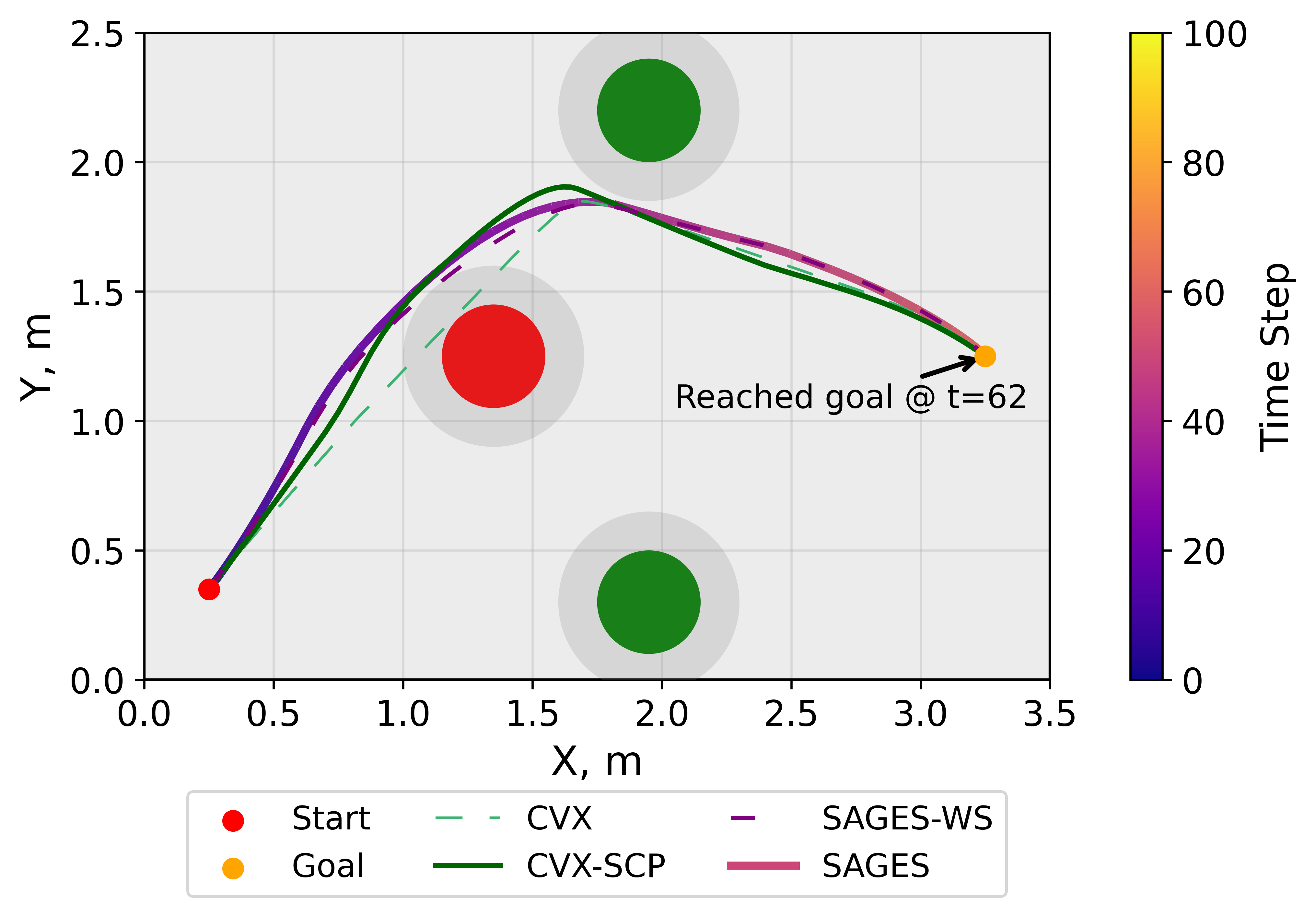
The generalization capabilities of SAGES are evaluated in two representative test scenarios involving nonlinear dynamics and obstacle avoidance constraints:

  1. Free-flyer robotic testbed
  2. Continuous-time fault-tolerant spacecraft proximity operation
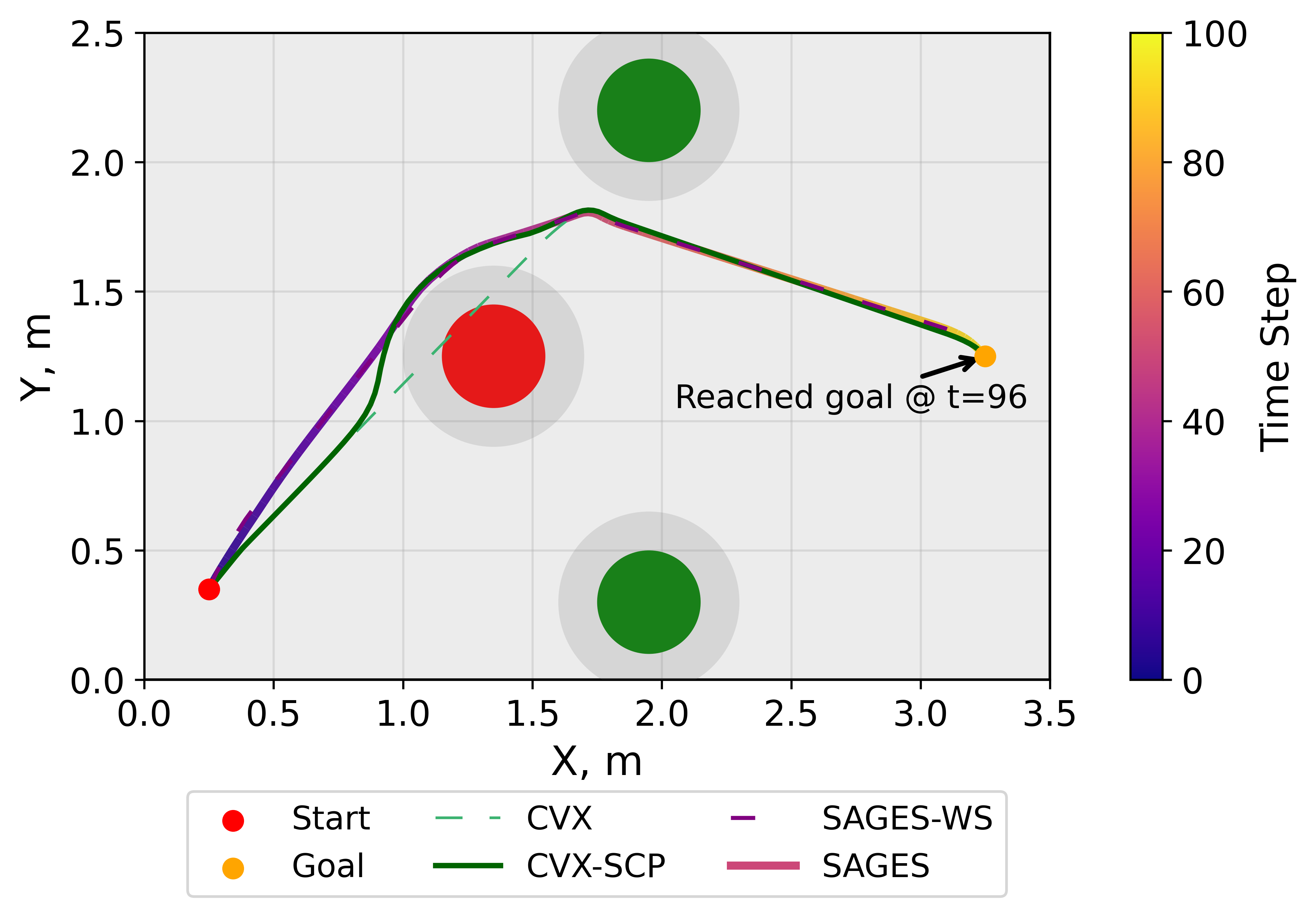
Free-flyer representative trajectory 1
Free-Flyer: Behavior 0
Free-flyer representative trajectory 2
Free-Flyer: Behavior 1
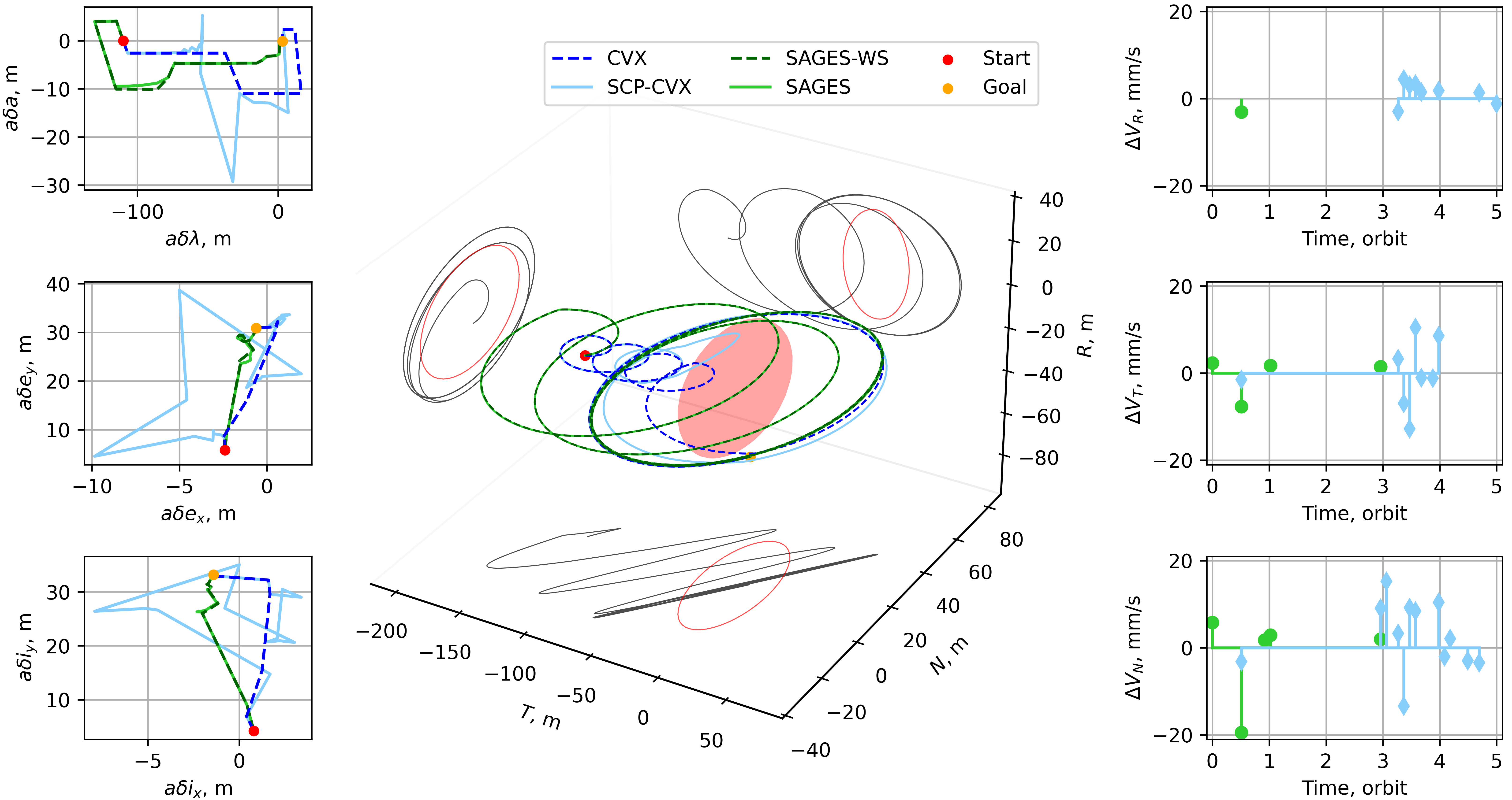
RPOD representative trajectory
Spacecraft proximity operations: Behavior 0

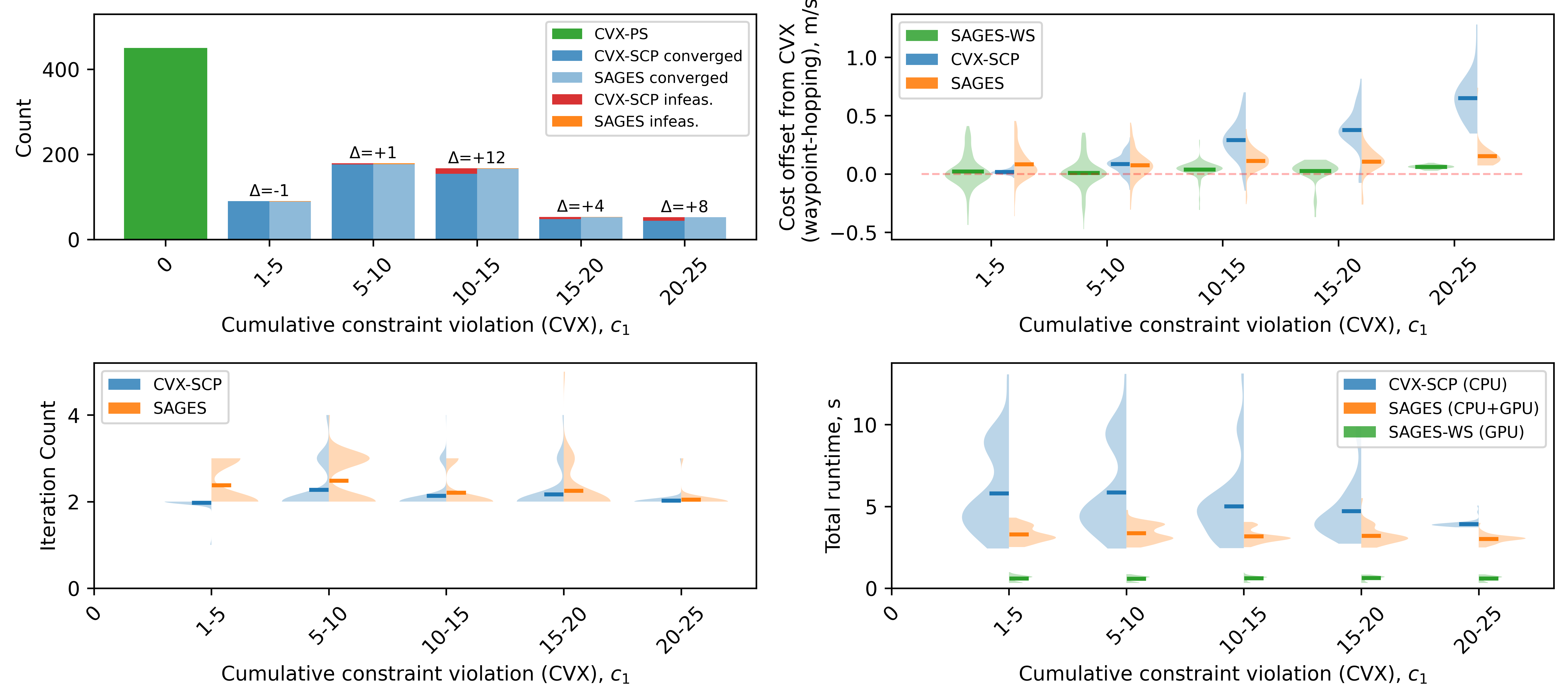
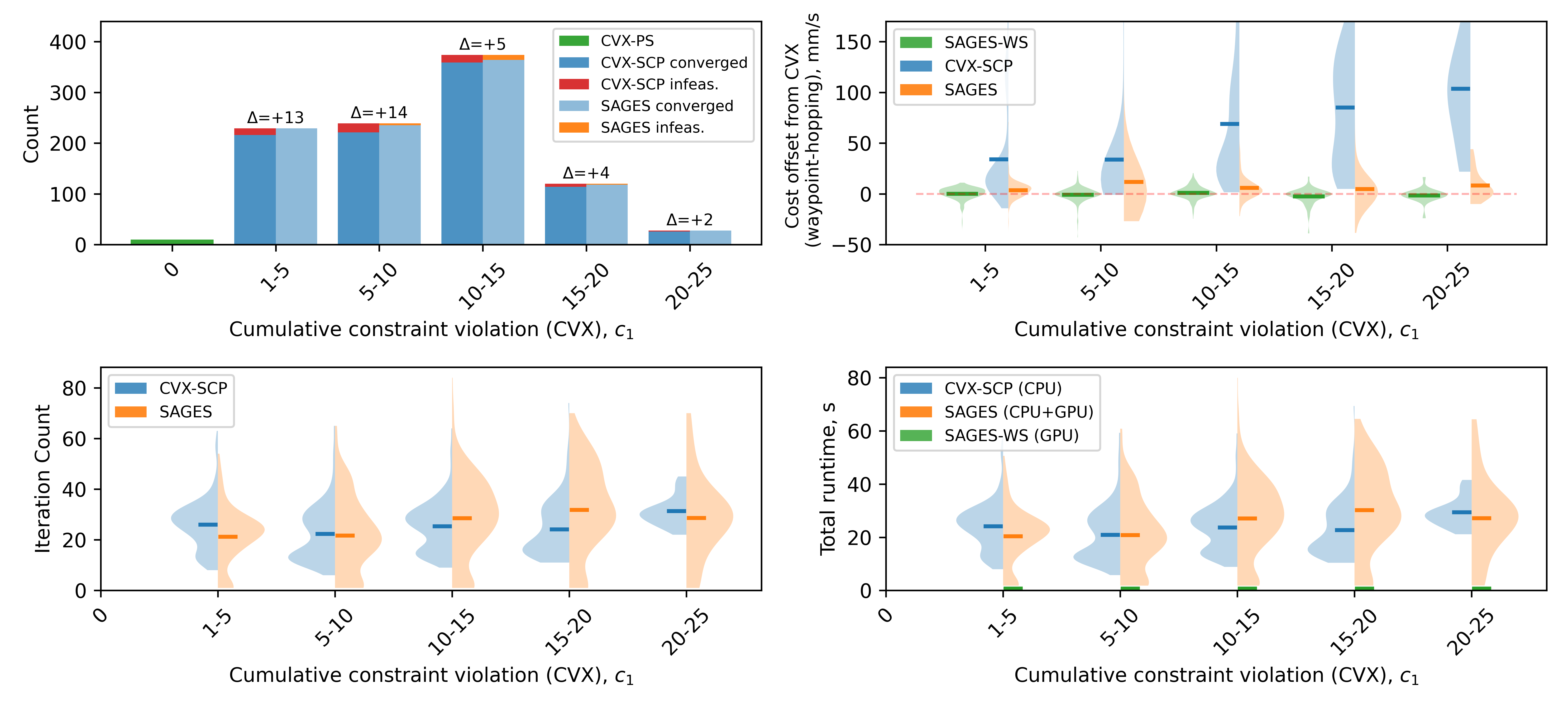
We evaluate the impact of SAGES warm-starting on SCP convergence and solution quality. The analysis compares convergence probability, objective optimality, iteration counts, and total runtime against a convex waypoint-hopping initialization. All statistics are computed on previously unseen problem instances and natural-language command templates, across both the free-flyer robotic testbed and spacecraft proximity operation scenarios, excluding cases that converge at the convex stage.

Free-flyer Scenario
Free-flyer Scenario
Spacecraft proximity operations

Experimental results

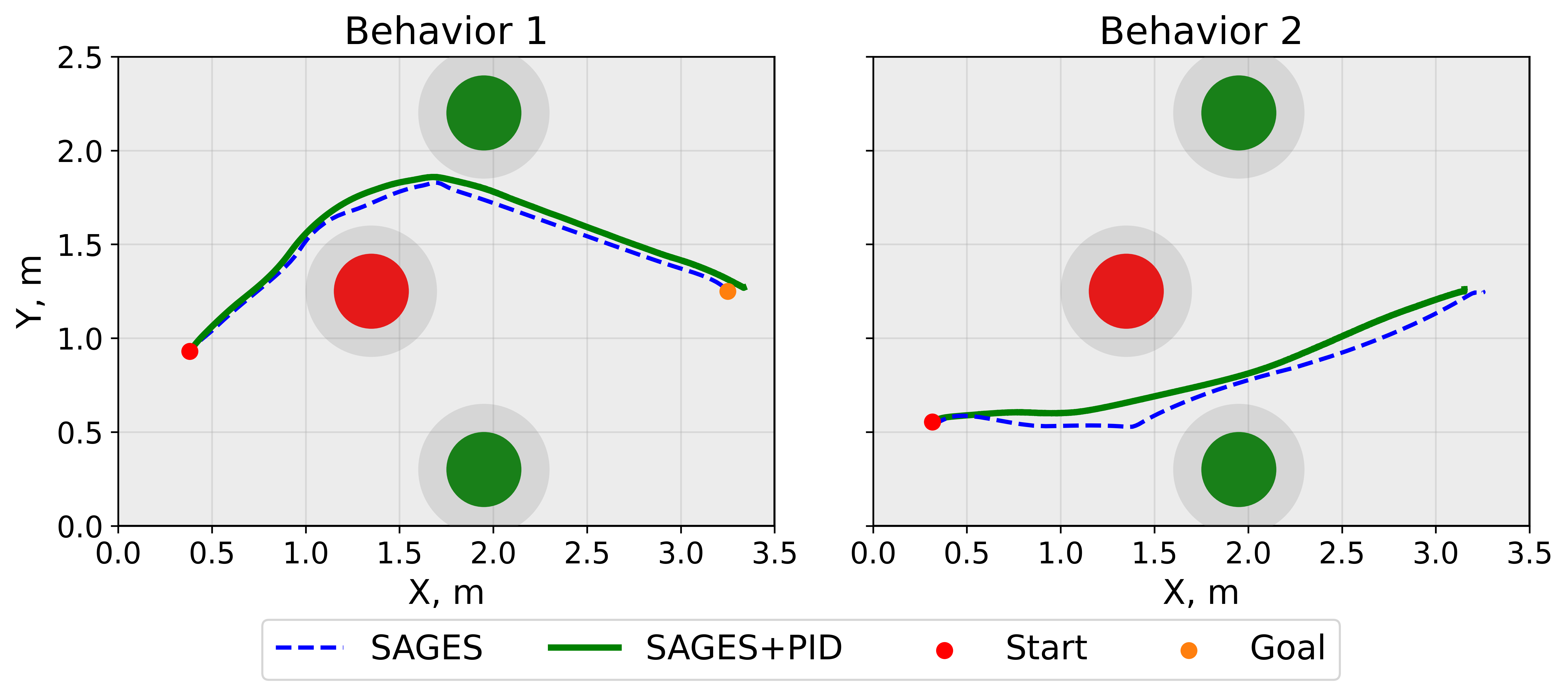
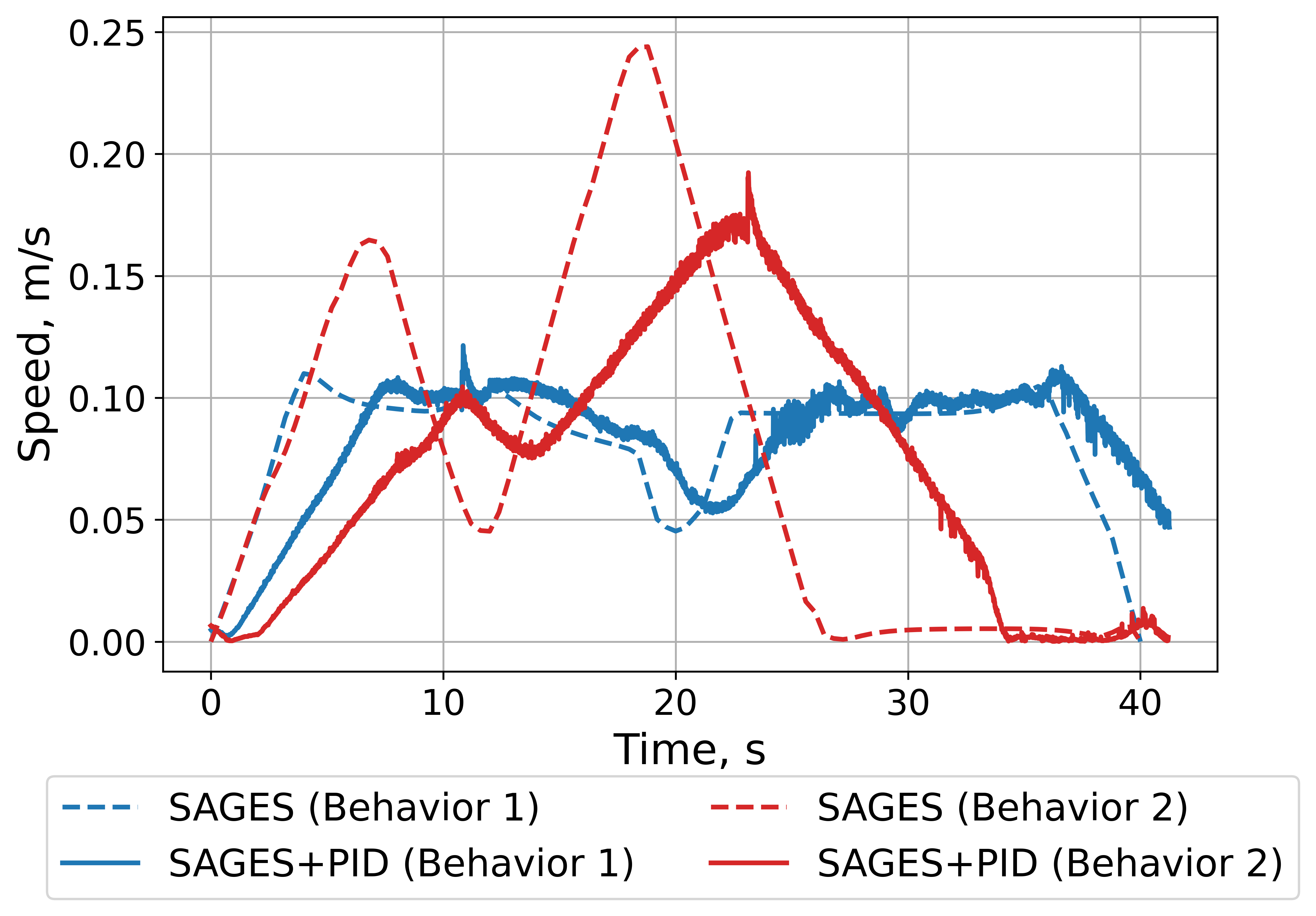
Experimental tests on a real-world robotic platform confirm the performance of SAGES. Running onboard an NVIDIA Jetson AGX Orin, SAGES generates fast, high-quality warm-start trajectories that are refined and tracked in real time on a free-flyer robotic testbed.

Trajectory executions and velocity histories validate behavior-dependent motion, including differences in speed profiles. The experiments confirm the practicality of proposed framework.

BibTeX

@article{sages_2026,
  author    = {Takubo, Y. and Dwivedi, A. and Ramkumar S. and Pabon, L. and Gammelli, D. and Pavone, M. and D'Amico, S.},
  title     = {Semantic Trajectory Generation for Goal-Oriented Spacecraft Rendezvous},
  journal   = {AIAA SCITECH 2026 Forum},
  year      = {2026},
  doi       = {10.2514/6.2026-0350},
}